- Pest control
- Pests
- Organisms that reduces the yield of crops
- Damages farming
- Pesticides
- Can be used to kill pests
- Advantages
- Doesn't harm humans, only pests
- Helps to keep the yield strong
- All crops capable
- Easy to apply
- Disadvantages
- Expensive
- Pest can develop resistance
- Harmful to environment
- Can kill insects
- Pollinating ones are important
- Can wipe out food chain
- Not 100% effective
- Biological control
- Controlling pests through introducing their natural predetors
- Advantages
- No poison involved
- Almost all crops are affected
- Disadvantages
- Expensive
- Difficult to apply
- Not suitable for allcrops
Tuesday, February 21, 2012
5.4 Pest Control and Biological Control

5.3 Fertilizer
- Fertilisers contain minerals
- nitrogen, phosphorus and potassium
- Helps plants grow Bigger + faster
- Crop yields are increased
- Nitrogen
- Makes protines
- Phosphates
- Make DNA/Membrane structure
- The minerals are dissolved first in water
- Plants can absorb them through the roots
- Active transport
- Types of fertilizer
- Organic Fertilizers
- Made from farmyard feces
- Mixture of animal manure and straw
- Goes through decomposition and fermentation
- Forms "Slurry"
- Applied to the fields afterwards
- Provides the important minerals for growth
- Inorganic/Artificial
- Made from inorganic compounds
- Potassium Nitrate
- Ammonium nitrate
- Formulated to obtain a specific amount carefully
- Applies as a solution with water
- The nitrates are released and absorbed by the roots
- Eutrophication
- Occurs when farmers apply inorganic fertilizers
- other mineral ions lost from removing the crops
- These ions are very soluble
- Easily leached from the soil
- Carried by water
- Can enter water ways
- Levels of the nitrates increases rapidly in lakes and rivers
- Increase in mineral ions
- Eutrophication
- Natural process resulting in bad waterways
- Due to the leaching ions
- Process
- Nitrate levels increase
- algae rreproduce rapidly
- Using the nitrates to make extra proteins
- Produces algai bloom
- Algea prevents light penetrating into water
- Plants unable to photosynthesize
- Dies
- Bacteria decay on dead plants
- Alge also dies
- Lack of nitrates
- The bacteria reproduces
- large amount of dead matter
- The water becomes anoxic
- without oxygen
- All life in the water dies
5.2 Crop Yields and CO2
- Rate of P/S
- CO2 + H2O -> Glucose + Oxygen
- Glucose -> Starch
- Increasing CO2 -> Increases the rate of reaction of P/S
- Higher Yeild
- Optimum Temperature
- Increasing temperature -> Increases the rate of reaction of P/S
- Higher Yeild
- Optimum Temperature
Thursday, February 16, 2012
5.1 Glasshouses
- Glasshouses are used to improve yield of crop
- Giving best possible conditions for photosynthesis
- Allows plants to grow earlier in the year
- Allows plants to grow in places in which they are not native to
- Can be controlled/manage via computer
- Conditions
- Temperature
- The sunlight heats the inside of the glass house
- The glass keeps the heat inside
- Electric/paraffin heaters can be used in cold weather
- Ventilators can cool the inside when too hot
- Light
- The glass lets sunlight in
- Artificial lights can be used when there is little/no sunlight
- Sunlight can be controlled using blinds
- Water
- Automatic watering systems can be installed
- Humidifiers can be installed to control the humidity

Tuesday, January 31, 2012
2.84 - 2.85 Nerve impulses and responses
- Nerve impulses pass through the CNS and the effectors create a respons
- Electrical impulses
- Signals/impulses created by the receptors which are send to the coordinator
- Method of transporting information of environmental change from the receptors to the coordinators in order to produce a response
- Decision making
- When receptors are affected by a change, they sends eletrical signals/impulses through the sensory nerves to the CNS
- The brain then coordinates the response
- Reflex action
- Very rapid, uncoordinated movement
- Ex: Pulling your leg up after stepping on a lego block in the dark
- Pain receptors detects the lego
- Sensory Nerve sends the electrical signal (Impulse) to the CNS, Brain
- The Motor nerve sends signals to the effector (Skin)
- The effector (Skin) produces a response
- Reflex
- Muscle contracts
- Leg is pulled up

2.83 Central Nervous System (CNS)
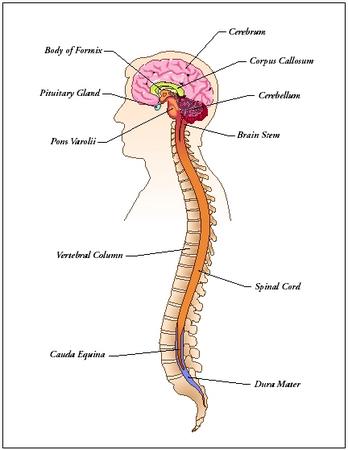
- Allows the body to respond to any change in the environment
- Consist of:
- Brain
- Spinal cord
- All the nerves branching out from the cord
- The CNS refers only to only the brain and the spinal cord
- Impulses from the receptors pass through the sensory nerves til they reach the spinal cord and te brain
- There are two ways in which the CSN handles these changes:
- Response coordinated by the brain
- Slower
- Reflex action
- Extra rapid responses to stimuli that by-pass the brain
2.82 Communication
- Motor Nerve (Neurone)
- Links coordinators with effectors
- Around a meter long
- Has tiny branches at each end
- Has long fibers at each end
- To carry the electrical impulses from the cell body to the Synaptic knob
- Connected to the muscle
- Mammals- The axon is surrounded by a scwhan cell
- Contains fat to increase the speed of the nerve conduction
- Endocrine System
- Endocrine Gland
- Produces hormones
- Can be Proteins/Steroids
- Secreted in to the blood
- Arrives at the "Target organ/tissue"
- May have multiple targets
- May have multiple effects
- Endocrine gland (Adrenal gland) > Blood (Adrenaline) > Target Tissue (Heart)
- |Nerves |Hormones
Speed of reaction | fast |slow
Type of transmission|Chemical signal |Electrochemical signal - Specificity |Can be a few/many body parts|Affects target cells/organs

Subscribe to:
Posts (Atom)